
Object Record
Images
Metadata
Catalog Number |
2022.05.07.01 |
Object Name |
Bottle, Medicine |
Date |
c.1910 |
Features |
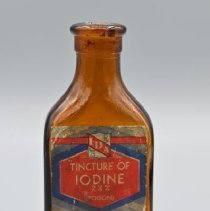
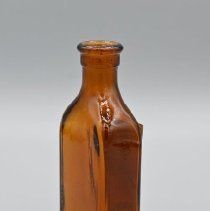
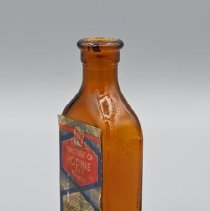
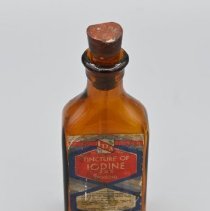
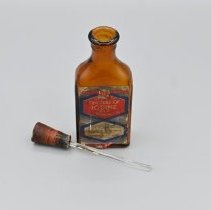
Translucent brown glass medicine bottle. Rectangular in shape with four sides tapering into a slimmer neck with slightly wider mouth. Front side of glass bottle has a water damaged paper label, coloured predominantly red, blue, and white. Label features has the IDA logo resembling a shield, below is a red hexagon with white text "TINCTURE OF//IODINE//2 1/2%. Below is a smaller white hexagon with small black text detailing product information. These components are surrounded by bands of varying shades of blue to fill out the background of the rectangular label. The bottom of the label is a red bar with white text "_ N IDA P_" remainder of label is torn off. Bottom of bottle has "1 6584 along with a diamond shape around the letter "D" pressed into the glass. |
Object Story |
This bottle, previously containing tincture of iodine was stored in the first aid kit originally owned by William Edward Vine c.1910 and stored at the family cottage located just south of the Napanee River. This bottle could have been added by William himself (1883-1948) or one of his descendants (listed under 2022.05.01). Tincture of iodine is a mixture of elemental iodine, potassium iodide, and ethyl alcohol. Early mixtures were distinctly stronger than the tincture found in this bottle with as much as 7% iodine, 5% potassium iodine, with the remainder being made up of (85%) ethyl alcohol. The tincture found in this bottle was likely a mix of elemental iodine with potassium iodide forming 2.5% with the remaining 97.5% either being 44% ethyl alcohol or 50% ethyl alcohol. Sources recounting the history of both iodine and it's use in medicine tend to be recounted from a eurocentric perspective, however a small number of these mentioned that people of ancient China utilized burnt seaweed or sea sponge (marine animal) to treat goiters, which would be reduced in size or cured as a result of the iodine found in the ash of these organisms. The new element "Iodine" was discovered in 1811 by Bernard Courtois, a French chemist working in the manufacturing of saltpetre (potassium nitrate), an essential component of gunpowder, during the Napoleonic wars. The process of producing saltpetre required a significant amount of ash from plant material, and when Bernard no longer had access to wood for burning he turned to seaweed. When the ash deposits were being cleaned out with acid one day he noticed it made violet coloured vapoour as well as leaving lustrous crystals when surfaces cooled. Theorizing that he had just discovered a new element but not having time to analyse it himself due to the ongoing war, Bernard gave samples to a few of his close friends and scientific colleagues to continue his work on this new substance. For over two years very little happened with this discovery until Sir Humphry Davy arrived in France from England with a small entourage on his way to Italy. Despite the war happening between England and France, when Napoleon caught wind of the chemist wanting to visit France he ordered that passports be issued. While on his visit he was given sample of "Unknown X", what iodine was at the time referred to by those few men who had been given a sample. With the chemistry set that Humphrey carried with him he was able to perform the tests to confirm the substance was in fact a new element. What followed has been described as an undignified scramble to achieve priority of discovery between the English Chemist and a French Chemist Gay-Lussac, who had already proved that "X" was a new elementary substance but who had yet to publish. Despite the health benefits of using burnt sponges on goiters being known not only in ancient China but in Europe as early as the middle ages, it was not until the discovery of iodine as an element, and eight years later the discovery of high levels of iodine in common sea sponges, that it was confirmed that it was iodine helping peoples goiters, known at that point to be related to the thyroid gland. The first reference to tincture of iodine comes 1839 when a surgeon John Davies published a textbook which included a section on treating cuts and similar wounds with tincture of iodine. It was subsequently used in the American Civil War. The final big push to use tincture of iodine was in World War I when it was utilized by many surgeons and part of many soldiers kits for disinfecting small to moderate sized wounds. It became clear however that tincture of iodine even at 7% was not sufficiently effective to disinfect the wounds faced by most soldiers. Even at 7% the tincture was known to commonly cause burns to the skin and going stronger only caused worse skin damage. Tincture of iodine fell out of favour in the subsequent decades, however iodine itself is still in use to treat many conditions and illnesses as of 2022. |
People |
Vine, William Edward Courtois, Benard Davy, Humphrey Sir Gay-Lussac, Joseph Louis Davies, John |
Subjects |
First Aid Kit Medicinal uses Tincture of Iodine Academic arms-race Iodine Discovery Napoleonic Wars American Civil War First World War |
Search Terms |
Napanee Napanee River Vine Cottage |