
Object Record
Images
Metadata
Catalog Number |
1955.38.01 |
Object Name |
Table, Butter |
Features |
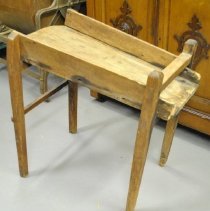
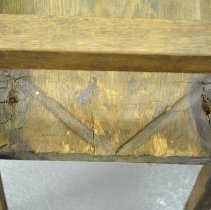
Working butter board with legs with small grooves where the brine could run off Platform, held up by four legs. One stretcher between back two legs. Platform sits on horizontal boards located between two front and two back legs, with front board significantly lower than back putting the platform on a downslope. Platform has two sides that angle towards the center directing flow of brine. Front of platform has a wide "V" carved in it. A bar sits above front end of drain, and is attached to front legs. |
Object Story |
Butter table- A different kind of butter worker emerged in the first part of the 19th century. A butter table seems like a good design: tilted to help liquid drain away through the holes, simple to make with home carpentry skills, and easy to operate. Moving the rod from side to side over the butter will press it and "work" it into good shape. The simplest of the "modern" butter workers are generally only slightly more complicated than using a rolling pin on a wooden table. In the course of the 1800s more sophisticated combinations of roller and board were introduced. Rollers cranked by a handle, using metal fixings, lightened the work without being too complicated or expensive. People started to patent a variety of designs. This particular butter table is from the Rombough Farm- near Centreville erected on lots 26 and 27 Concession 6th. Township of Camden. The house was built in 1831 and owned by Squire Jacob Rombough, a Justice of the Peace and the first court in Camden was held in the upstairs of this house. Jacob Rombough was the great grandfather of the donor. |
People |
Rombough, Jacob (1794-1887) |
Subjects |
Butterworking Farming Agriculture |
Search Terms |
Lennox and Addington County Centreville |