
Object Record
Images
Metadata
Catalog Number |
2025.46.01 |
Object Name |
Siding |
Date |
1792? |
Features |
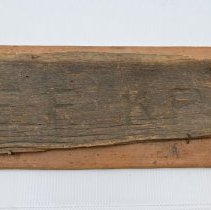
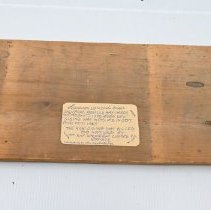
Wooden mount has rusted nails driven in, holding a wooden board in place. Dark wood, roughly rectangular shape, top and bottom edges angled so right side of board is shorter than left. Hole driven in, top-right side. Wood is hand-engraved: "E.F. K.P." Top half of K is faded, may be an R. |
Object Story |
Built in 1792 by Loyalist settlers on land donated by Paul Huff, Hay Bay Church was the first meeting house for Loyalists in Ontario, and is the oldest surviving Methodist building in Canada. It was a significant station on the first Methodist circuit in Upper Canada and was the site of the first Methodist camp meeting in Upper Canada. On June 16th, 1784 United Empire Loyalists from Major Van Alstine’s military regiment arrived in the Township of Adolphustown, on land that is now the United Empire Loyalist Park in The Town of Greater Napanee. There were 258 people of all ages, containing a wide diversity of military ranks, religious beliefs and skills, all bound together by their loyalty to British rule. Each family was provided with a tent, some clothing, farming implements and tools, and a cow. They would live in a village of tents during the summer until the land was surveyed and divided into lots. The British government had promised them support for three years. Their first ‘need’ for religious ceremonies occurred within days of arrival, at the death of a young child, who was buried in the first burial in what would become the "Loyalist Cemetery". Even before they had left the 13 colonies, many Loyalists had heard of and had attended a Methodist service. Some had become disillusioned with the Church of England, for it was a large, cumbersome, institution which was slow to adapt to the changes of new settlements. Methodism was much more agile, with the only requirement for a Methodist meeting/service was someone willing to preach and a few others willing to listen. On February 3rd, 1792, ‘’The Covenant of 1792" was written with the commitment of building a ‘meeting house’. The building was to measure 30x36 x two stories high. This house of worship would be bigger than any known residence in the area and located in a field as a focal point for future camp meetings. Fancy details were not there as the desire of the early Methodists was to be plain and as sparing as possible. The Methodist faith based out of the newly formed USA, was not permitted to own land in Upper Canada, and so the ‘meeting house’ was built on land owned by the Huff family. Enlarged in 1835, Old Hay Bay Church closed as a regular place of worship in 1860 and becoming a farm storage area. In 1910 it was reacquired and restored by the Methodist Church. It was recognized as a historic site in 1957, and was deemed a national historic site of Canada in 1999. It currently houses a museum and is still used for annual services by the United Church of Canada. |
People |
Alkenbrack, Wesley Mackinnon Alkenbrack, Wesley MacKinnon, 1918-2008 |
Subjects |
Construction Lumber Wooden Siding Church Methodist Hay Bay Church |
Search Terms |
Old Hay Bay Church Hay Bay |