
Object Record
Images
Metadata
Catalog Number |
2017.26.18 |
Object Name |
Pitcher, Water |
Date |
c1910 |
Year Range to |
1930 |
Features |
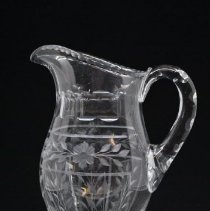
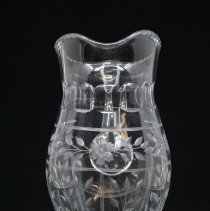
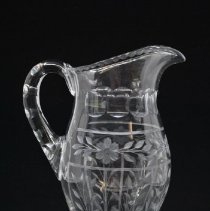
Pitcher, water, flare based, thumb print motif on handle; grooved beading edging on spout; etched repeating leaf and aster motif; pressed star pattern on bottom. Attributed to Deseronto Glass |
Object Story |
The glass cutting factory that was located in Deseronto Ontario was owned by Harry G. Clapperton. Harry was born in England in December of 1873. At the age of 12 he immigrated to Ohio in the United States. Beginning in 1890, Harry completed a 10 year apprenticeship with the Libbey Glass Company. During his time with the Libbey Glass Company Harry married Isabel Morse in Lucas Ohio, July 12, 1896. They proceeded to have 5 children between 1897 and 1908. After his apprenticeship finished and he was a qualified glass cutter Harry moved to Toronto Ontario to work for the Gowans, Kent & Co., Ltd. He was the first person to cut glass in Canada. In 1905 Harry decided to start his own glass cutting company, which would be located in Toronto. The next year N.F. Gundy became a partner and the company name was changed to Gundy, Clapperton Co., Ltd. The partnership continued until sometime between 1913 and 1916. Glass pieces from this period in the company history were marked with a "C G Co" in a three leaf clover. By 1916 the company was back to just being owned by Clapperton. A new shop was opened in Deseronto Ontario the same year. The company would stay in Deseronto for 15 years in three buildings with three different names. The first was on the corner of Mill and Main Street, and was called Quinte Glass. The company employed 10-15 local people and was managed by a glass cutter/minister from England. The company moved locations in 1918; this second building was still in Deseronto. The name changed with the location and was now Quinte General manufacturing Company. The third location for the glass company was again in Deseronto but this time along the shore line, the exact address is not known however a newspaper article from 1931 calls the building the Bates and McMehan building. They made the moved in 1923. The building was a large brick structure which was supposed to be fire proof. The name again changed to Clapperton Glass Works. The third building had the same manager as the second; Ernie Lyons. Disaster struck June 18, 1931, when the entire building went up in flames, coupled with several explosions from cartridges located in Clapperton's office and a new shipment of sulfuric acid. At least 35 people had worked in the factory before the fire. With his factory completely destroyed Harry Clapperton returned to Toronto and would pass away five years later March 10, 1936. The Clapperton glass company, under its various names, produced three types of cut glass. The first types was cut glass produced on blank glass pieces mostly from Wallaceburg. These simple pieces were inexpensive and were often used to train workers. The second type was when the glass pieces they brought in weren't blank but had already had the pattern pressed into them. The person working on these pieces would have to cut the pattern and would occasionally embellish it. The third type was a very high quality of cut glass where totally blank glass pieces were imported from France, Belgium or the Libbey factory in Ohio. Skilled glass cutters would trace their own patterns into the glass then proceed to cut it into the glass using cutting wheels. Based on the anecdotes of the people who worked at the factories, no Deseronto cut glass was ever marked. It is known however that some Clapperton pieces not from Deseronto were marked with a "C" in a three leaf clover, however at what time this mark was used is unknown. |
People |
Clapperton, Harry G. Clapperton, Isabel (nee Morse) Gundy, N.F. |
Subjects |
1910s 1920s Glass Industry Glassware Cut glass |
Search Terms |
Deseronto Clapperton glass works |